Showing posts with label human rights. Show all posts

Sunday, 26 August 2018

One Year on: Rohingya Peoples Still Living in Refugee Camps in Bangladesh

It’s been a year since the Myanmar (Burma) military, conducted raids on Rohingya villages in Rakhine state. The so called ‘clearance operations,’ as described by the military were to find Arakan Rohingya Salvation Army (Arsa) militants, who on the 25th August 2017, attacked and killed 12 security personnel.

640px-Kutupalong_Refugee_Camp_(John_Owens-VOA)

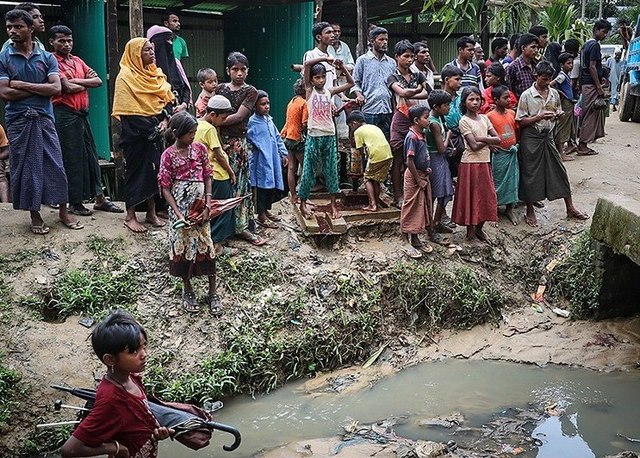
For over a month, the Myanmar military were claimed to have attacked hundreds of villages, burning, lutting, killing and raping along the way - forcing over 700,000 Rohingya to flee to refugee camps across the border in Bangladesh. The Myanmar authorities both civilian and military denied the extent of the violent crackdown, calling the operation as anti-terrorism raids.

The international community were slow in condemning the actions by the Myanmar military, and dithered on a response. The international community published statements calling for the end of the violent crackdown, with some United Nations officials calling the atrocities as ethnic cleansing. The United Nations Security Council (UNSC) were unable to agree to take more affirmative action.

A year later, most of the 700,000 Rohingya still live in makeshift camps along the Myanmar/Bangladesh border, while the Myanmar civilian government and the military generals dither on resolving the issues. All that has happened since, is the government led by State Counsellor Aung San Suu Kyi (Prime Minister) have agreed with the Bangladeshi authorities that over the next two years Rohingya refugees will be repatriated back to Rakhine state on a voluntary basis. If and when this process begins, it will have the support of the UNDP and UNHCR, who in June this year signed a Memorandum of Understanding with the Myanmar government, to assist in the repatriation process.  These a steps in the right direction for both the Myanmar civilian government and the international community, although without assurances of rights and protections for returning Rohingya, there are no guarantees that similar atrocities and will not occur in the future.
640px-Rohingya_displaced_Muslims_021

The repatriation process would likely rebuild villages and supply aid for returning Rohingya, but the issue of citizenship and freedom of movement have not been resolved and look unlikely in the near future, that’s if government official signals are correct. The Myanmar government and much of the majority Buddhist population view the Rohingya as Bengali Muslims from Bangladesh and have no rights to Myanmar citizenship since they were stripped of this under the 1982 Citizenship Act. These one million or so stateless peoples can not keep carrying on living in fear and lacking any human rights.

If the international community are advocates of the responsibility to protect, then increased pressure on the Myanmar government and military on the issue of citizenship and protection is required. The only major steps of cohesion on the Myanmar government and military has been a few statements of condemnation from world leaders, and limited unilateral sanctions. A year after the crackdown, the U.S have placed sanctions on a few military generals and police officials .

Myanmar is still in democratic transition, and Aung San Suu Kyi is trying to balance civilian governance, while maintaining relations with the military, who still hold sway over security, society and the economy. A return of tougher sanction will do more harm to Aung San’s efforts to bring democracy and rebuild the economy, but more targeted sanctions against key military generals, and a full break in relations with the military establishment by the west could force the hand of the military gripe over Myanmar

As for accountability for the inproportionate attacks on the Rohingya population,  There has been calls for the International Criminal Court (ICC) to investigate the military actions - although Myanmar is a non-party to  the Rome statute, the UNSC has the power to refer the case to the ICC. Though it is not as straightforward, this would require agreement by all members including the permanent five (U.S, UK French, Russia & China). China has been reluctant to blame or pressure the Myanmar government or military in the past and would likely block any moves to refer a case to the ICC. Nonetheless this is an avenue that other council members need to keep pushing, as the only real prospect for international action against the Myanmar military.

Furthermore, the Myanmar civilian government has announced a independent commission of inquiry into human rights violations during the August 2017 crackdown. Not much detail has been released, except that the commission will include a mix of domestic and international representatives and experts. On paper, this sounds like owning up to responsibility for the violence, but how independent will it be. Will the military establishment fully cooperate? As most Rohingya refugees will not be returning to Myanmar any time soon, will the commision visit the refugee camps in Bangladesh and talk to refugees about their experiences? Will the commission have the power to prosecute or at least recommend individuals to be put on trial? Theses questions have not been answered yet - and likely this commission will just show that the government is taking action, but nothing concrete happens. The military for instance are unlikely to cooperate or allow their personnel to be prosecuted. And the Rohingya refugees in Bangladesh are likely not want to talk to a commission of enquiry conducted on behalf of the Myanmar government, who have not stood up for their rights, independent or not. To overcome these issues, a more independent commission would be better of been run by the UN, even in cooperation with the Myanmar’s own independent  commission.

Monday, 3 February 2014

What a Shambles the Sochi Games have become


Only a few more days till the opening ceremony of the Winter Olympics in Sochi, Russia, with thousands of athletes and spectators arriving in mass to compete and watch the games, that have been criticized by many, both in Russia and globally.

These games have been reported to have cost around 30 billion pounds, although the exact amount has not been officially released by the organizers. If it’s true, the games in Sochi would be by far the most costly; even three times the amount London paid to host the 2012 summer games. That is a lot of money for a country that is still trying to develop into an economic powerhouse, where large sections of the population still live in conditions much like in the old Soviet days.

Apart from the huge cost of holding the games, reports of corruption and abuse against the tens of thousands of foreign workers brought into construct the venues for the games has shown the world what a shambles these games have become. Some of the International Olympic Committee and others have concerns that billions have been pocketed by developers close to President Putin and other key officials. On top of the reported corruption, abuse and non payment of foreign workers have highlighted the lack of respect for human rights that Russian officials and game organizers have.

The number one concern just days till the event kicks off is the threat of a terrorist attack, from a number of possible groups or individuals with grievances against the Russian state. At this event Al-Qaeda are not of concern, but more home grown terrorist threats are. Sochi is only a few thousand miles away from the Chechen border, where Russia has been fighting a brutal guerrilla war against separatist rebels for a number of decades. Various groups from Chechnya and others have threatened to target Sochi and the games. Earlier bombings in other cities nearby in December and January have shown what threat these games are under, even with such a large security presence.

President Putin and the organizers can not take all the blame, the IOC has also some criticisms concerning how bidding cities and countries are granted hosting rights. I do wonder at times how certain cities and countries are selected to hold major sporting events. Much like FIFA’s granting of the 2022 World Cup to Qatar (a country with a bad human rights record, especially against foreign workers, and weather conditions not suited to holding a football event during a northern summer), Sochi is also a bad choose for holding a Winter Olympic games. As mentioned earlier, Russia does not have a good human rights record, corruption has been rife through out the seven years since been granted the games, there are major security concerns due to the close proximity to the Chechen border, and on top of this there is not enough snow fall in Sochi, compared to past winter Olympics.

This is not the first Olympics that the IOC has granted to a county been accused of major human rights abuses and perceived inability to stage an international sporting event. In 2001, the IOC granted the 2008 summer games to Beijing, China, for the first time in its history. Although, the games went without any major security or other incidents, except for the pro Tibetan protests during the Olympic flame relay, the games were some what overshadowed by China’s bad human rights record, corruption during the organization of the games, and restrictions placed on  the international press and spectators.

Perhaps the IOC and other international sporting associations should consider more carefully which cities and countries will host major sporting events in the future. I do acknowledge that all courtiers have the rights to hosting these events, not just a select few, but stricter criteria perhaps should be placed on a bidding nation. I think that this would further encourage perspective countries to address issues of security, human rights and corruption concerns, which many of the recent major sporting events have experienced.       


The international community will probably never know the exact  extent of corruption or human rights abuses, but already the Sochi games have shown what a shambles they have become and show signs of continuing on this path, although I do hope for the athletes sack, who have been preparing for four years, and travelling spectators that all goes well.

Friday, 29 November 2013

Aung San Suu Kyi's address at the Sydney Opera House

On Wednesday this week, Sydney was previledged to have Daw Aung San Suu Kyi address an enthusiastic crowd at the Opera House.

View a replay of this great event here:


Thursday, 28 February 2013

The Syrian crises no closer to a solution


The crisis in Syria has taken another turn, with the United States (US) new Secretary of State John Kerry announcing that America, along with other nations are planning to give further aid to the more moderate faction of the opposition rebels to help them overcome President Bashar al-Assad’s regime. Kerry has stated that no weaponry will be given to Syrian rebels, in fear that they may end up in the hands of the extremists, instead armoured vehicles and training could be provided.

As a meeting in Paris is about to take place between Syrian opposition representatives and the international community to discuss giving further aid to the rebels, the fighting does not seem any closer to ending, in a conflict where about 70,000 people have been killed.

Increasing humanitarian aid and providing limited military material to a divided opposition with many different interests is all well for the present situation on the ground in Syria, but long term strategies are needed to prevent further deaths and regional instability. The body armour, vehicles and training been reported to be included in the assistance package could assist in saving the lives of the rebel fighters from attacks on the ground, but would not help them from strikes from the air.

Although I do agree that weapons should not be provided to the rebels, I do however think air cover, in the name of a no-fly zone, similar to the one put in place over Libya by British and French fighter jets, should be provided by the international community. Half the battle would be won, if rebel forces did not have to worry about being attacked from the air, and a no-fly zone could pressure either Assad to back down and negotiating with the opposition coalition or bringing the conflict to a quick military ending.

I acknowledge the fact that Russia as a permanent member of the United Nations Security Council (UNSC) supports the Assad regime and have vetoed past efforts to install a no-fly zone and for foreign military intervention in Syria, arguing that outside military interference will not solve the conflict, but instead inflame the already volatile situation. However, I disagree with Russia’s argument, as over the last 18 months or so, rebel groups have not got any closer to ousting Assad and peaceful negotiations have failed after many attempts. Although the reasons for Russia’s support stem from them having a naval base in Syria, more effort by the international community to persuade Russia to support a no-fly zone over Syria and to pressure Assad to negotiate with opposition forces should be a major priority. 

Tuesday, 5 February 2013

The Australian Coalitions asylum seeker policy may break international law


The first group of irregular maritime arrivals arrived at the regional processing centre in Manus Island, PNG today. The 19 people, comprising families from Sri Lanka and Iran, departed Christmas Island late yesterday. Transfers to Manus Island and Nauru will continue in coming weeks and months.
(Source: WikiCommons | Photo credit: DIAC Images)

Coinciding with a United Nations High Commission for Refugees (UNHCR) report, which condemns the conditions that detainees suffer on Manus Island, the Australian Coalition has announced that if they win the next election, they will reintroduce policy of ‘turning back the boats.’ But this policy has been viewed by both the UNHCR and legal experts as breaking international law and obligations as a contracted state to the refugee convention.


On top of this announcement fromthe opposition, the UNHCR has published a report outlining criticism against the poor conditions that asylum seeker detainees suffer on Manus Island in Papua New Guinea. UNHCR's regional representative, Richard Towle and Greens Senator Sarah Hanson-Young, who visited the island detention centre last week have said that women and Children have to stay in the same facilities as single men in temporary housing, under hot and humid weather.

I think that if asylum seekers are that despite to risk their lives coming by boat, we in Australia, should as a first world country at least offer better conditions and facilities for asylum seekers. I do agree that we need to detain people arriving illegally for processing purposes, but surly we are humane enough to provide more then just tents and a few tarps.

On the policy announcement by the Opposition, I think that this policy is flawed both morally and politically. As Australia has a good record in providing overseas humanitarian assistants and promoting the protection of human rights, we have an obligation to continue this effort in the future, but bring back past failed policies would ruin the image of a good global citizen that thousands of Australian’s have worked hard to achieve.      

Saturday, 25 August 2012

Julian Assange: what a fuss


The on going case against Wikileaks founder Julian Assange, which has been dragging on for more then a year, does not seem to be ending, because after taking refuge in the Ecuadorian embassy in London for the past few months, Assange has finally been granted political asylum by the Ecuadorian government. What this means is that Assange could escape from being extradited to Sweden to answer alligations of rape by Swedish prosecutors if he is granted permission to leave the Ecuadorian embassy and travel to Ecuador. The catch is, the British authorities will not allow Assange to leave the Ecuadorian embassy in London, saying that waiting police will arrest him if he tries to leave.

Outside the Ecuadorian embassy in London
This case goes back to 2011, when Swedish prosecutors filed extradition proceedings in Britain. After months of High court deliberation, Sweden was given permission to extradite Assange; but before they could take him into custody, he entered the Ecuadorian embassy in London claiming asylum. Assange is seeking political asylum in Ecuador, because he claims that the United States (U.S) will try to extradite him to America once he is sent to Sweden, as he claims the case against him is politically motivated, although the U.S government deny there is a case against him or want to extradite him to America. Law experts in Sweden also say that under the current law, they can not extradite anyone if they either face the death penalty or a case is politically motivated.

In my opinion, if Assange is not guilty of rape, which he has been accused of by two Swedish women, he should go to Stockholm and fight against the charges. All this fuss over the last few months seems to me that he could perhaps be guilty of the charges. On the claims by Assange and his supports, that U.S authorities will try to extradite him to America after he arrives in Sweden, to be some what strange, as I would have thought, the U.S would have as much chance of  extraditing him from Britain, as in Sweden.

It's possible, that the case against Assange in this context, has nothing to do with Wikileaks, after all. If he is not guilty, then go and prove it himself that he is indeed a decent human being just trying to do the world good.