Showing posts with label United Nations Security Council. Show all posts

Sunday, 26 August 2018

One Year on: Rohingya Peoples Still Living in Refugee Camps in Bangladesh

It’s been a year since the Myanmar (Burma) military, conducted raids on Rohingya villages in Rakhine state. The so called ‘clearance operations,’ as described by the military were to find Arakan Rohingya Salvation Army (Arsa) militants, who on the 25th August 2017, attacked and killed 12 security personnel.

640px-Kutupalong_Refugee_Camp_(John_Owens-VOA)

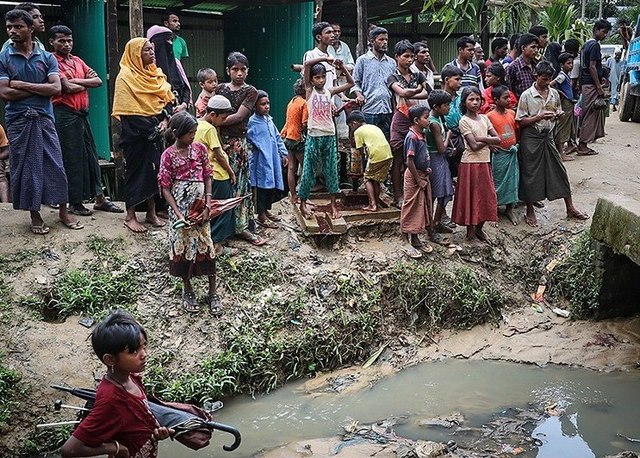
For over a month, the Myanmar military were claimed to have attacked hundreds of villages, burning, lutting, killing and raping along the way - forcing over 700,000 Rohingya to flee to refugee camps across the border in Bangladesh. The Myanmar authorities both civilian and military denied the extent of the violent crackdown, calling the operation as anti-terrorism raids.

The international community were slow in condemning the actions by the Myanmar military, and dithered on a response. The international community published statements calling for the end of the violent crackdown, with some United Nations officials calling the atrocities as ethnic cleansing. The United Nations Security Council (UNSC) were unable to agree to take more affirmative action.

A year later, most of the 700,000 Rohingya still live in makeshift camps along the Myanmar/Bangladesh border, while the Myanmar civilian government and the military generals dither on resolving the issues. All that has happened since, is the government led by State Counsellor Aung San Suu Kyi (Prime Minister) have agreed with the Bangladeshi authorities that over the next two years Rohingya refugees will be repatriated back to Rakhine state on a voluntary basis. If and when this process begins, it will have the support of the UNDP and UNHCR, who in June this year signed a Memorandum of Understanding with the Myanmar government, to assist in the repatriation process.  These a steps in the right direction for both the Myanmar civilian government and the international community, although without assurances of rights and protections for returning Rohingya, there are no guarantees that similar atrocities and will not occur in the future.
640px-Rohingya_displaced_Muslims_021

The repatriation process would likely rebuild villages and supply aid for returning Rohingya, but the issue of citizenship and freedom of movement have not been resolved and look unlikely in the near future, that’s if government official signals are correct. The Myanmar government and much of the majority Buddhist population view the Rohingya as Bengali Muslims from Bangladesh and have no rights to Myanmar citizenship since they were stripped of this under the 1982 Citizenship Act. These one million or so stateless peoples can not keep carrying on living in fear and lacking any human rights.

If the international community are advocates of the responsibility to protect, then increased pressure on the Myanmar government and military on the issue of citizenship and protection is required. The only major steps of cohesion on the Myanmar government and military has been a few statements of condemnation from world leaders, and limited unilateral sanctions. A year after the crackdown, the U.S have placed sanctions on a few military generals and police officials .

Myanmar is still in democratic transition, and Aung San Suu Kyi is trying to balance civilian governance, while maintaining relations with the military, who still hold sway over security, society and the economy. A return of tougher sanction will do more harm to Aung San’s efforts to bring democracy and rebuild the economy, but more targeted sanctions against key military generals, and a full break in relations with the military establishment by the west could force the hand of the military gripe over Myanmar

As for accountability for the inproportionate attacks on the Rohingya population,  There has been calls for the International Criminal Court (ICC) to investigate the military actions - although Myanmar is a non-party to  the Rome statute, the UNSC has the power to refer the case to the ICC. Though it is not as straightforward, this would require agreement by all members including the permanent five (U.S, UK French, Russia & China). China has been reluctant to blame or pressure the Myanmar government or military in the past and would likely block any moves to refer a case to the ICC. Nonetheless this is an avenue that other council members need to keep pushing, as the only real prospect for international action against the Myanmar military.

Furthermore, the Myanmar civilian government has announced a independent commission of inquiry into human rights violations during the August 2017 crackdown. Not much detail has been released, except that the commission will include a mix of domestic and international representatives and experts. On paper, this sounds like owning up to responsibility for the violence, but how independent will it be. Will the military establishment fully cooperate? As most Rohingya refugees will not be returning to Myanmar any time soon, will the commision visit the refugee camps in Bangladesh and talk to refugees about their experiences? Will the commission have the power to prosecute or at least recommend individuals to be put on trial? Theses questions have not been answered yet - and likely this commission will just show that the government is taking action, but nothing concrete happens. The military for instance are unlikely to cooperate or allow their personnel to be prosecuted. And the Rohingya refugees in Bangladesh are likely not want to talk to a commission of enquiry conducted on behalf of the Myanmar government, who have not stood up for their rights, independent or not. To overcome these issues, a more independent commission would be better of been run by the UN, even in cooperation with the Myanmar’s own independent  commission.

Monday, 27 November 2017

The International Community Still Failing to Protect After Srebrenica

There was slight justice and humanity on the 22nd of November 2017, when Ratko Mladić was sentenced to life in prison by the International Criminal Tribunal for the Former Yugoslavia (ICTY). If you are not sure who Mladić is, he was the Chief of Staff of the Bosnian Serb forces during the time of the 1995 Srebrenica massacre, where 8,000 Muslim men and boys were killed by Bosnian Serb troops, and the four year siege of the Bosnian capital, Sarajevo.

Mladić was indicted by the ICTY in 1996, but was only captured in 2011 and transferred to the Hague. After a long four year trial, he was found guilty of 10 out of 11 charges, including genocide, war crimes and crimes against humanity.

Along with the conviction of the former Bosnian Serb leader Radovan Karadžić in 2016, who was sentenced to 40 years imprisonment, some form of justice for the victims families and the Bosnian nation has been found. It has been over 20 years since the Srebrenica massacre and the siege of Sarajevo, but these two verdicts placed on two of the most senior figures in the genocide will be welcomed, but the underlying effect of preventing future or halting present acts of genocide and crimes against humanity still seem beyond the international community.

The atrocities committed by all sides during the wars in the former Yugoslavia, along with the Rwandan genocide, just to mention a few, are still felt today, with genocide and crimes against humanity still occurring in the 21st century. In the years preceding the Bosnian war and the Rwandan genocide, the international community declared “never again.” Over two decades since these atrocities, genocide and crimes against humanity are still been committed in Syria, Myanmar and in many other countries.

Myanmar as a point in case, where thousands of Rohingya Muslims have been killed and hundreds of thousands fleeing to escape the bloody hands of the Myanmar military. The situation in Myanmar has been occurring for decades, with the international community basically sitting on its hands, unwilling to intervene and stop the ongoing ethnic cleansing. A fear that too much pressure on the Myanmar military or civilian government led by Aung San Suu Kyi, would be counter productive in democratising a former military ruled country. But allowing the military to conduct indiscriminate attacks on Rohingya Muslims may also be counter productive in bring peace and human rights to a country which has suffered decades of violence and abuse in the hands of the military.   

As for Syria, the ongoing conflict over the past six years has claimed hundreds of thousands of lives, with millions fleeing the violence, and a nation in ruin. This civil conflict could have possibly been prevented from escalating, if not for a lack of consensus and individual national interests of major international and regional powers. All sides to the conflict have committed war crimes and crimes against humanity, though Bashar Al Assad’s forces have committed some of the most horrific  atrocities, when deploying chemical weapons on his own people. It will be seen if Assad and others are ever brought to trial in the Hague. Somehow this seems unlikely.   

Holding perpetrators to account decades after such atrocities brings a sense of justice for the victims families and humanity in general, but there needs to be more emphases in finding greater political will and consensus, especially at the United Nations Security Council (UNSC), to prevent and to intervene in cases of occurring genocide and other acts of atrocities.

Wednesday, 7 September 2016

The Race to the United Nations Hotseat

As we are gripped by the Presidential election campaign between Donald Trump and Hillary Clinton, another less newsworthy contest is taking place in another part of the United States, that been in the United Nations Headquarters in New York.


In the past 5 months, the International organisation has been in the process of deciding who will take over from  Ban-Ki Moon, as the next Secretary-General of the UN. All up 11 candidates have put their names in the hat to become the next chief diplomat and administrator of the UN. Six men and five women are contesting for the rolecoming from different regions and backgroundssome have formerly held elected office in their perspective countries or head of UN departments or other international organisations.


The process of choosing the next SG has changed slightly, with each candidate having the opportunity to be interviewed by members of the General Assembly (GA), and hold a live debate. This is the first time that such events have happened within the process of choosing a SG. Some might think that a candidate is elected by all UN members, but that is far from the truth, only the 15 members of the Security Council (UNSC), in behind closed door meetings decide in a number of rounds of what's called  ‘straw polling,’ on who they would present to the GA as their preferred candidate, who then technically rubber stamp the least objectionable person of the Permanent five UNSC members (P5: U.S, UK, France, Russia and China). So in reality the P5, especially the U.S and Russia come to some agreement on which candidate will best suit their own interests, rather than someone who can best manage the UN and deal with current and future crisis or events crippling the world.


Many UN analysts, commentators and the media predicted at the beginning of the process, that Irina Bokova of Bulgaria, the current head of UNESCO would likely become the next UNSG-but the former Portuguese Prime Minister and UN high commissioner for refugees António Guterre is leading the contest, with the most support among the UNSC members, after the first few straw poll meetings. Ms Bokova was seen as favourite, as there seems to be an unwritten rule that regions take turns to have a UNSG, and as a Eastern European has not held this position in the past, that it was time for a candidate from this region, for which Russia has supported this notion. Furthermore, there has also been support for a women Secretary-General.


Although Ms Bokova is well qualified and experienced, along with all the other candidates, but it seems the U.S and other member states are more inclined towards Mr Guterre, as the new UNSG. We must assume that the U.S own national interests lay with Mr Guterre, as a safe bet, rather than obliging to the calls for choosing  a women, and from a Eastern European state, by not considering Ms Bokova. Unless Russia begins to voice an outright rejection of Mr Guterre, and fully commit to having a Eastern European take the position, we will likely Mr Guterre or another male candidate as the next Secretary-General. If Russia does outright reject Mr Guterre, another candidate, Miroslav Lajcak, the Slovak foreign minister, has raced up to second position, and could become the preferred choice, if both the U.S and Russia are still at loggerheads.  


It is a shame that a women candidate could not be in serious consideration for the position, as it is about time that gender not be an issue when choosing the next head of the UN. Ms Bokova is as qualified and experienced as Mr Guterre, but due to past cold war animosities and the current international system, the U.S was always inclined not to proffer a candidate from an Eastern European state, especially Ms Bokova who has irritated the U.S in the past.  

So as it currently stands, a women candidate may have to wait till next time, as either the front runner Mr Guterre, or second placed Mr Lajcak are likely to become the next UNSG, unless no agreement is found over these two candidates, meaning we might get a surprise chose. The announcement of who takes over from Ban Ki-Moon should be made in November, and until then it will be interesting to see how far the U.S and Russia will go to block each others preferred  candidates. But at some stage over the next two-three months a compromise  will have to be made. Watch this space.